;readme.md
- Story based, using original video, audio, noise effect visuals, and text-based expressions with simple interactive aspects. It follows the biblical tellings of the locusts spawn and reign, it is fairly loosely based on the actual story as I am neither specifically religious or familiar with the bible, yet I am using direct quotes for each opening scene for dramatic effect.
- Three scenes/video/audio/visuals separated from one another but relate as they are in the same universe. All commands to progress within each menu option (scene change, progress to next scene) within the modes are executed by keypress, to return to the main menu, mousepress the final scene (when one cannot keypress anymore to see, text displayed ordering to do so).
- Menu option has the three games/”variations”: wormwood, signs of the swarm, the end times. When the user hover over the texts, before clicking to initiate the scene/game, a subtext/caption under the title texts appears. Wormwood; “Shaft of the Abyss”, devastation. Signs of the Swarm; “Destroyer”, destruction. The end times; “God’s hate”, desolation.
- The MAIN MENU is an ascii style image of a locust, user is encouraged to fill in/draw it, just an extra interactive feature.
- The purpose of this project was for me to learn math, vectors, and classes using tutorials and source codes.
GITHUB REPO: https://github.com/consumedlocusts/cart253/tree/839791eeecb455933e57eae11fb3589eeded6de7/topics/locust.host
WORKING: https://consumedlocusts.github.io/cart253/topics/locust.host/
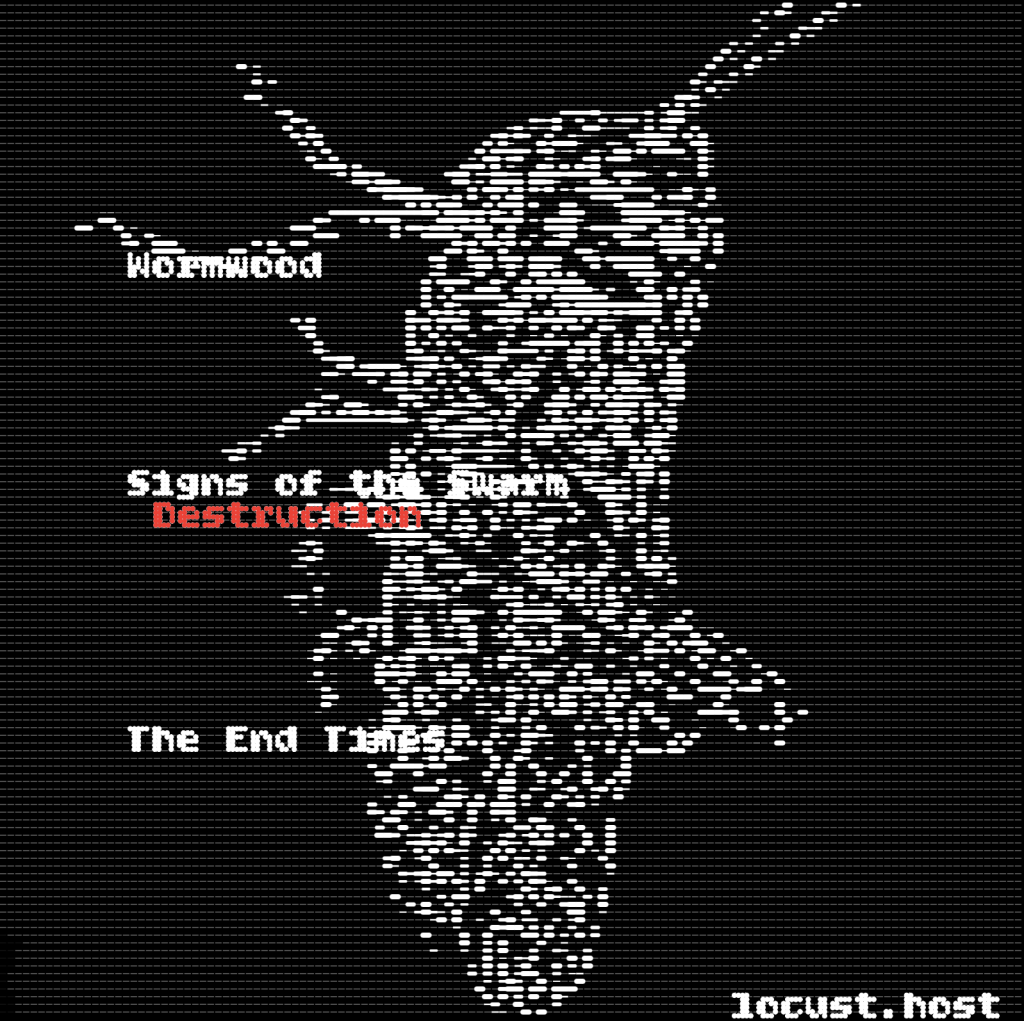
locust.host, menue screen capture, p5.js, 2026.
;description/rambling
Titled after my github username “locust.host”, I am finally able to apply everything absorbed from the course into a triad (quad) of heavily stylized playthroughs. It is built on everything I engaged with during CART 253; pixel reading, text animation, sound analysis, for loop indexing, classes, state progression, and particle systems.
Each “storyline” abstractly relies on different techniques, such as ASCII conversion, drifting particles shaped into sentences, audio-reactive waves(personal song for this feature), brightness-mapped pixel systems, and masked scenes that reveal content through interaction. Additionally, and most important, I also learned to manage complexity, which became crucial when working across four interconnected scripts. The highlighted “state” within all of these scripts is found as the particle “de-attractor” (mountain image), using a base code;https://openprocessing.org/sketch/2308471 a hidden p5 graphics canvas (integral to using particles in ALL of the states, is p5.graphics) loads the mountain image and reads its pixel data(brightness, then silhouettes the image), these new coordinates become destinations for the free particles in the “swarm”. The particles are then matched with these points and begin moving toward them using lerp. As each particle reaches its assigned spot, the shape of the mountain slowly appears, yet the particles dismember (hence “de-attractor”) once the mouse is hovering/in contact with them. The image is not drawn directly but is reconstructed (then deconstructed again) through many particles following pixel data. This is repeated in the state following but instead of “free particles” it is directly animated, and no longer contains interactive particles (the locust image cannot be distorted).
Now I know that with intense time and practice I can create experiences that merge narrative, interactivity, sound, and visual complexity. I look forward to developing this skill further and continuing to integrate computational thinking into my art. In short, before this course, I would not have believed that I could build something like “locust.host”.
I have many concepts to further understand deeply, such as object-oriented programming(classes, explored heavily in locust.host, a whole essay on its own), cleaner code structuring, and optimizing beautiful large particle systems. However, the existing foundation allows me to approach these challenges without fear. I am excited by the idea that code can support the interactive installations I want to build in sculpture, especially projects that combine physical structures with projection, sensors, and responsive visuals.